
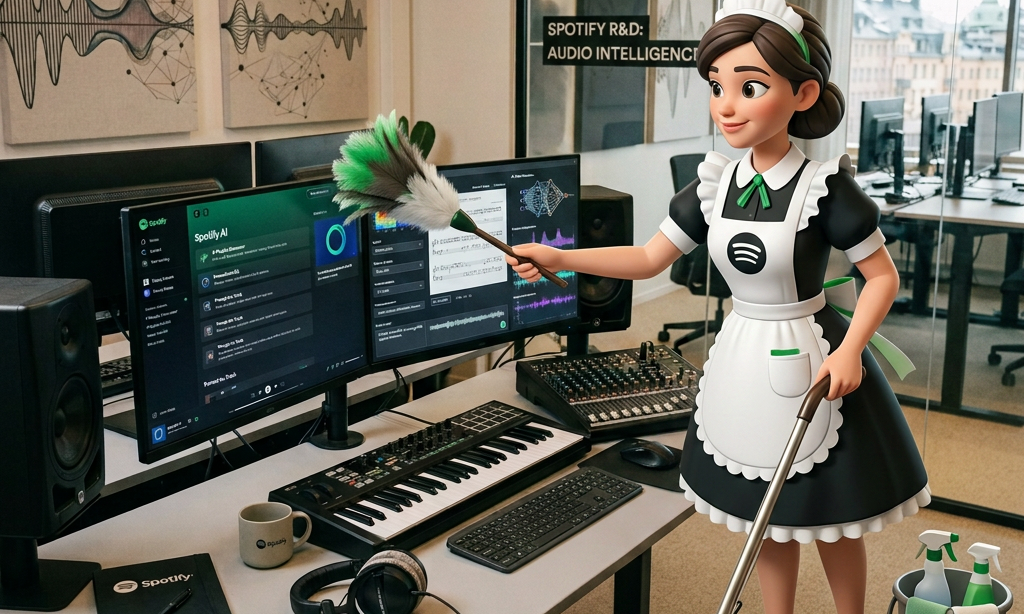
Let’s stop pretending the streaming landscape isn’t getting weird.
For the past two years, DSPs have been quietly drowning in machine-generated slop, phantom artists, and synthetic personas built to farm passive playlist streams. The DSP business model was practically inviting it, until real human artists, managers, and labels started screaming loud enough for the boardrooms to hear.
Spotify’s latest play, spearheaded by their Music Policy team, isn’t a blanket ban on artificial intelligence. It’s something much sharper: a strict operational boundary between human creators and synthetic avatars.
If you make a living creating music, this is the policy shift you need to pay attention to.
The Breakdown: What Spotify Is Rolling Out
The streaming giant isn’t pulling AI off the platform entirely. Instead, they’re drawing a line in the sand regarding who, or what, gets to build a profile, get verified, and leverage the algorithm.
Here is the three-pillar ecosystem Spotify has put in place:
- AI Persona Labeling: Artist profiles presenting photorealistic or entirely AI-generated identities will carry a dedicated AI Persona badge across profiles, search results, and track rows. Creators can self-disclose via Spotify for Artists, while Spotify’s internal teams will manually review and badge accounts meeting high listener thresholds.
- Algorithmic & Editorial Quarantine: This is the real kicker. Music tied to an AI Persona will be excluded from Spotify’s editorial and algorithmic recommendations by default. Unless a user actively searches for and hits “Follow” on a synthetic avatar, that AI artist will never show up on Discover Weekly, Release Radar, or editorial playlists.
- Verified by Spotify vs. AI Credits: Spotify is explicitly separating the tool from the identity. Real artists using AI tools (for vocal tuning, stem separation, or generative sound design) can submit AI Credits to disclose their production process. Crucially, using AI tools will not disqualify a human artist from getting a Verified by Spotify badge. However, dedicated AI Personas are strictly barred from verification.
Technical & Process Impact: What This Means for Producers
If you’re sitting in Ableton or Logic using generative tools to chop up samples or fine-tune synths, don’t panic. Spotify is not policing your DAW plugins.
The distinction hinges on metadata and public identity.
If your distributor ships metadata crediting a real human, and your profile represents an actual artist with linked socials, gig histories, and verified distribution channels, you are safe. You can, and should, use the AI Credits tag via supported aggregators to disclose machine-assisted elements without fearing down-ranking.
However, if you are attempting to deploy low-effort synthetic “faceless” acts onto the platform to passively catch chill-hop or ambient playlist algorithms, the gravy train just hit a brick wall. Deindexing AI Personas from recommendation engines strips away the core growth mechanism for automated music farms.
Alongside this, Spotify’s Artist Profile Protection gives legitimate acts a gatekeeping tool. By requiring approval steps before a distributor can drop your name onto a feature or metadata tag, it effectively stops spam accounts from hijacking real artist profiles and stealing algorithmic momentum.
The Raw Truth: Why This Pivot Really Happened
Let’s skip the corporate PR about “trust and transparency” for a second.
Spotify didn’t roll this out purely out of the goodness of their heart. They did it because the platform was dangerously close to an identity crisis.
When synthetic, prompt-generated noise competes for the exact same royalty pool as an independent artist grinding out touring logistics and spending endless hours in the studio, the system breaks. Major labels were threatening war, and listeners were getting annoyed by fake artists cluttering their personalized feeds.
By walling off AI Personas, Spotify kills two birds with one stone:
- They protect the economic value of real human catalog.
- They shift the financial burden back onto synthetic creators, forcing them to spend actual marketing dollars to build a direct following rather than leeching free algorithmic traffic.
The Bottom Line
Technology will always outpace policy, but Spotify finally made the right call here.
If you use AI as an instrument, disclose it, embrace it, and keep building your craft. But if you’re trying to hide behind a synthetic mask to game a streaming algorithm, your reach just got cut at the knees.
Real fandom has always been about human connection—and the algorithm is finally being recalibrated to reflect that.


Leave a Reply